Data Centers and Greater Philadelphia: What They Bring and Who Benefits

By Saloni Tandon, Director of Research & Analytics
Edited by Jeff Hornstein, Executive Director
October 28, 2026
Part two of a two-part series
Summary
The region pays for data centers together; a handful of school districts and townships collect. Even if every proposed project is built, local taxes would offset about a third of the electricity costs the region’s customers bear.
Part one of this Leading Indicators series found that data centers are raising electricity costs across Greater Philadelphia whether or not one is built nearby, because the region buys power in one market shared by 13 states and D.C. This brief looks at the other side of the ledger. The benefits are real but narrow: local property tax, mostly to the school districts hosting projects, and a few hundred permanent jobs per campus. They arrive years after the costs, and only where projects are approved and taxed in full.
To show who comes out ahead, the Economy League built a county-by-county ledger that sets each county’s share of the attributed electricity cost against the local tax its data centers would pay. Under every scenario, most of the region’s households pay and collect nothing. Philadelphia, with the most households, the lowest incomes and no proposed projects, is the largest net payer.
Reading this leading indicator
Figures are labeled by who produced them. Tax projections for Limerick and Upper Merion come from developers; other tax figures are Economy League extrapolations from those projections. The electricity cost is part one’s illustration, a model estimate rather than an amount on anyone’s bill. Job figures are direct jobs as stated by employers and developers. The brief does not add estimated ripple effects (indirect and induced jobs), which require a regional economic model and are where most published job claims inflate. Dollars are nominal.
Key findings
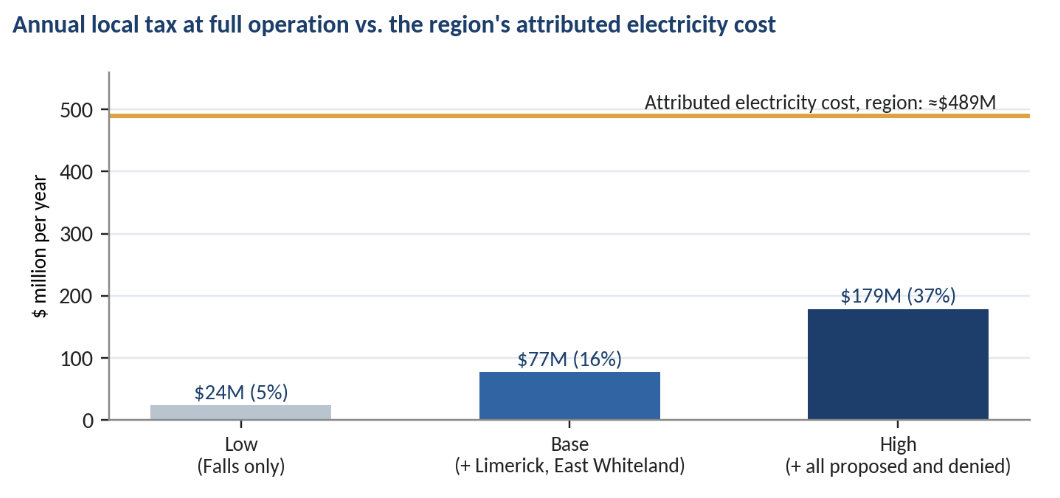
- Benefits cover a fraction of regional costs. Local property tax from the region’s projects would equal about 16 percent of the attributed electricity cost (about $489 million a year) if approved and pending projects are built, and about 37 percent if every proposed project, including two already denied, is built.
- Most of the region pays and collects nothing. Each household pays an estimated $59 to $98 a year. Only Montgomery County’s projected taxes exceed what its households pay; Philadelphia’s households pay about $50 million a year with no offset.
- The burden is regressive. The same household cost takes about 0.13 percent of median income in Philadelphia, twice the share in Chester County.
- The sole campus currently under construction will pay little new tax until 2036. Amazon’s Falls Township campus sits in a tax-abatement zone through December 2035, and the township has no signed community benefit agreement.
- Permanent jobs are few. Approved and pending projects would employ about 950 people directly once running. Most hiring is in construction and ends when building does.
- Headline job claims often overstate. Several widely cited figures count construction, indirect jobs or statewide totals; Georgia’s own auditors had to cut their jobs estimate by more than two-thirds.
Where the benefits show up
Local property tax
Data centers are among the most valuable buildings per acre a tax base can hold, and they add no students. That is why the largest projected benefits go to school districts. But in Greater Philadelphia nearly all of this revenue is still a projection.
| Project | Size | Status, Oct. 2026 | Annual local tax at full operation |
|---|---|---|---|
| Amazon campus, Falls Twp., Bucks | ~2M sq ft | Under construction | Fixed payment through 2035; ~$24M after (ELGP estimate) |
| Limerick, Montgomery | 2.8M sq ft | Conditional-use hearings | ~$42.6M, $33.4M to Spring-Ford SD (developer’s expert) |
| Sentinel/Green Fig, East Whiteland, Chester | 887K sq ft | Approved; work paused | ~$11M (ELGP estimate) |
| Five sites, Upper Merion, Montgomery | 4.6M sq ft | Denied Aug. 13; developer suing | $55.4M, $37.9M to Upper Merion SD (developer-commissioned) |
| Conshohocken-area campus, Montgomery | ~2M sq ft | Proposed | ~$24M (ELGP estimate) |
| Pennhurst site, East Vincent, Chester | 1.9M sq ft | Denied | ~$23M (ELGP estimate) |
The projections should be read cautiously. In January 2026 the Limerick developer estimated $10 million to $20 million a year; its expert’s later $42.6 million assumes a taxable value of $1,200 per square foot, a modeling choice rather than an assessment. Economy League estimates apply $12 per square foot, the lower of the two developer projections. Assessments can be appealed once buildings exist, and abatements push revenue years out. Construction costs also vary across Pennsylvania, from high-wage union markets to non-union ones, and assessed values tend to follow cost. Varying the ELGP rate from $9 to $15 per square foot moves base-scenario tax from $69 million to $86 million a year, 14 to 18 percent of the region’s attributed cost; the conclusion holds.
Nearby campuses show how long abatements can delay the payoff, even after buildings are running. Amazon’s Salem Township campus in Luzerne County has a 10-year, 70 percent abatement; the township expects about $7 million a year once it ends. The Berwick Area School District budgeted no new Amazon revenue this year, although AWS is already its third-largest taxpayer. Across the Delaware in Vineland, N.J., just outside the region, the DataOne/Nebius AI campus is being built under a five-year payment in lieu of taxes agreement, the amount of which has not been published.
Jobs and wages
Construction is the largest job effect, and it is temporary. At Homer City in Indiana County, the developer reported more than 1,800 tradespeople on site in September 2026. Virginia’s legislative auditor estimated that the state’s data center industry supports about 74,000 jobs, $5.5 billion in labor income and $9.1 billion in GDP a year, but that 80 percent of those jobs come from construction and last only as long as the building pipeline.
Permanent jobs are counted in the hundreds per campus: AWS expects 400 to 500 at Falls, Limerick’s expert projected 451, and East Whiteland’s developer cited 50. Statewide, Amazon’s $20 billion commitment promises at least 1,250 jobs, about one for every $16 million invested. AWS projects average salaries of $80,000 to $100,000 at its Homer City campus, so the jobs are well paid even if few.
Reading the job claims. Headline figures often measure something other than what they appear to.
| Claim | What it actually measures |
|---|---|
| Amazon will create 1,250 jobs | A statewide minimum across all its Pennsylvania campuses, not Falls alone |
| Amazon has created 27,000 Pennsylvania jobs | All Amazon operations since 2010, mostly warehouses |
| Upper Merion would support about 15,000 jobs a year | Average annual jobs during construction, including indirect and induced; developer-commissioned |
| East Whiteland will bring 3,000 jobs | Construction jobs; the developer cites 50 permanent |
| Georgia’s data centers created 5,471 operations jobs | The state’s own figure, corrected weeks later to 1,641 |
The Georgia case is a caution for any jurisdiction relying on projected impacts: its auditors’ first estimate overstated jobs and economic value by more than three times before a correction in January 2026.
Workforce, power and land
Workforce. Training pipelines are small but durable. The first AWS pre-apprenticeship at Bucks County Community College graduated 19 of 22 students in April 2026, and Bucks, Luzerne, Lehigh Carbon and Northampton community colleges have formed a data center training consortium. Swatara Township’s community benefits agreement sets aside $1 million for workforce scholarships. The electrical, mechanical, fiber and controls skills involved carry over to manufacturing, utilities and life sciences, so this benefit outlasts any one building boom.
Power supply. Data center contracts are financing generation in Pennsylvania. Talen’s 17-year, roughly $18 billion agreement to supply Amazon with up to 1,920 megawatts from the Susquehanna nuclear plant moved to a grid-connected arrangement in April 2026. Microsoft’s 20-year agreement is paying for the restart of the 835-megawatt Crane (Three Mile Island) reactor, targeted for 2027; a Constellation-commissioned study projects 3,400 jobs. PPL has announced $6.8 billion in transmission investment through 2028. As demonstrated in part one of this series, though, demand is still growing faster than supply, so these investments have not yet translated into lower bills.
Land. Several sites reuse long-idle industrial land: Falls sits on the former U.S. Steel Fairless Works, Homer City on what was Pennsylvania’s largest coal plant. Reuse avoids building on farmland, but in Falls the abatement that made redevelopment possible also defers the tax benefit.
The regional ledger: who pays and who collects
Costs and benefits accrue to different people. The electricity cost is spread across every customer on the grid; the tax benefit goes to the few school districts and townships that host projects. Setting them side by side, county by county, shows how the region as a whole fares.
The ledger starts from part one’s estimate that about $330 million a year in 2028/29 capacity costs in PECO’s service area are attributable to data centers. That works out to about $78 per resident, or roughly $489 million across the 11-county region. About 40 percent falls on households, an assumption tested at 30 to 50 percent.
| Area | Attributed electricity cost, all customers ($M/yr) | Paid by households ($M/yr) | Local tax at full operation, base scenario ($M/yr) | Tax minus household cost ($M/yr) |
|---|---|---|---|---|
| Philadelphia | 125.5 | 50.2 | 0 | −50.2 |
| Montgomery | 67.0 | 26.8 | 42.6 | +15.8 |
| Bucks | 50.6 | 20.2 | 24.0 (from 2036) | +3.8 |
| Delaware | 45.1 | 18.1 | 0 | −18.1 |
| Chester | 41.8 | 16.7 | 10.6 | −6.1 |
| South Jersey (4 counties) | 105.9 | 42.3 | 0 | −42.3 |
| New Castle and Cecil | 52.8 | 21.1 | 0 | −21.1 |
| Region | 488.6 | 195.4 | 77.2 | −118.2 |
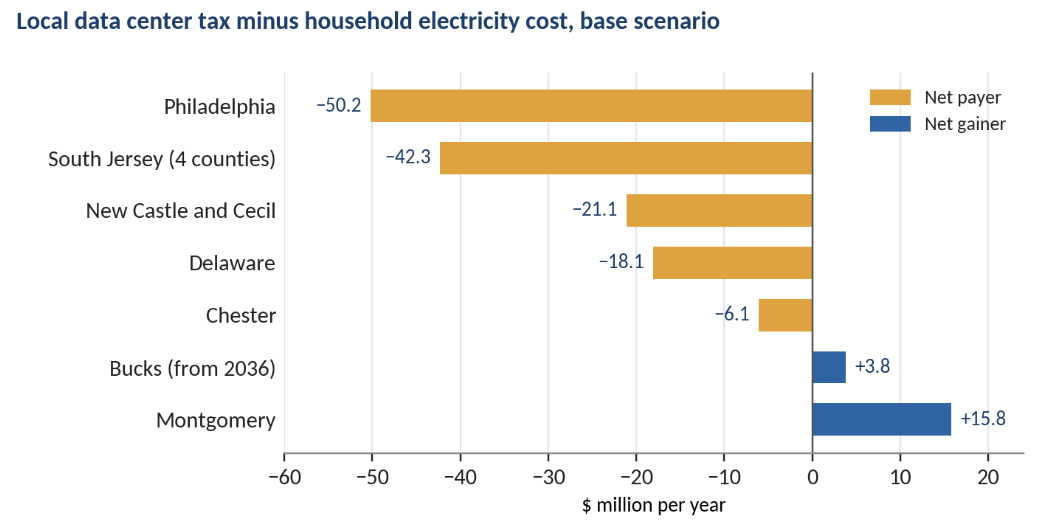
The base scenario counts projects under construction, approved or in hearings: Falls, Limerick and East Whiteland. Three findings stand out.
Building more narrows the gap but does not close it. Local tax at full operation equals 5 percent of the region’s attributed cost with Falls alone, 16 percent in the base scenario and 37 percent if all six projects are built. Because the power market is shared, the region’s costs are the same in all three scenarios; local decisions change only the benefit side.
Households everywhere pay about the same; incomes differ. A typical household pays an estimated $59 to $98 a year, about $6.50 a month at the midpoint. That is roughly 0.13 percent of median household income in Philadelphia and 0.07 percent in Chester County. The benefit, meanwhile, flows to school districts in some of the region’s higher-income suburbs.
Spending shifts as well as bills. Every dollar households pay in higher electricity costs is a dollar not spent at local businesses: about $195 million a year across the region, $50 million of it in Philadelphia. That loss is spread thinly across the whole regional economy, while the roughly 950 direct permanent jobs in the base scenario are concentrated in Bucks, Montgomery and Chester counties.
This is a distribution ledger, not a profit-and-loss statement. Some of what customers pay is income to power plants, several of them in the region, and local harms such as water use and noise are not counted. Business electricity costs, about 60 percent of the total, are included in the cost column but their effect on jobs is not modeled.
What other regions show
Where data center benefits have been measured, the terms mattered more than the buildings. Large local gains came where counties taxed buildings and equipment fully; they shrank where state and local tax breaks were stacked.
| Region | What has been delivered | The catch |
|---|---|---|
| Loudoun County, VA | ≈$1.2B in data center property tax in FY2026, 39% of the budget; real property tax rate cut from $1.145 to $0.805 per $100 since 2016 | Took 20+ years; the county keeps a stabilization fund because it depends so heavily on one industry |
| Virginia (state) | About 74,000 jobs supported, mostly in construction | The sales tax exemption returns roughly 48 cents in state revenue per dollar forgone (state auditor) |
| Georgia | 1,641 operations jobs and 8,505 construction jobs in 2025 (corrected figures) | $474.2M in forgone sales tax in 2025; the state estimates 70% of construction would have happened anyway |
| Central Ohio (New Albany) | About $10M a year in city development charges | Property tax abatements of 65–100%; one campus got a 15-year full abatement for 20 jobs |
Pennsylvania taxes real estate but not business equipment, so it cannot copy Loudoun. Its own sales tax exemption is projected to cost $188.4 million in FY2026–27, rising to $517.2 million by FY2030–31, and no study shows whether it changes where data centers locate.
What makes benefits materialize
- Full taxation. Each local abatement delays the main benefit. AWS told Indiana County it would not seek local tax incentives at Homer City, which shows large operators can locate in Pennsylvania without them.
- Enforceable community benefit agreements. Swatara Township’s agreement totals $120.3 million in payments tied to construction milestones, including $38 million for a police and fire headquarters; Middlesex Township’s totals $14 million. Falls Township, by contrast, has none. Executive Order 2026-05 (August 18, 2026) requires developers seeking the state tax break or faster permitting to offer the host municipality and county such an agreement, and directs the Department of Community and Economic Development to publish model agreements. It does not require that one be signed, or that residents be at the table.
- Sharing across the region. Because the region pays together, a share of data center tax base could be pooled, as the Twin Cities have done with commercial and industrial tax-base growth since the 1970s. A share of any savings from scaling back the state exemption could fund bill assistance for low-income households.
- Reporting. Annual public data on jobs, wages and taxes paid by each exemption recipient would let the state measure what it is buying.
What to watch
| Signs benefits are materializing | Signs they are not |
|---|---|
| Assessed values at Limerick or East Whiteland come in near projections | Successful assessment appeals, or new abatements on approved projects |
| Signed community benefit agreements in Southeastern Pennsylvania with milestone payments | Projects proceed without agreements, as in Falls |
| Pennsbury, Spring-Ford and Great Valley school budgets book actual data center revenue | Budgets keep listing data center revenue as future, as in Berwick |
| Falls reaches the 400 to 500 permanent jobs AWS has stated | Construction ends with no path into permanent or related trades jobs |
| The state publishes jobs and investment by exemption recipient | Exemption cost rises with no matching jobs data |
| Approvals and court rulings (Limerick hearings, Upper Merion lawsuit, Pennhurst) move projects into the base scenario | Approvals stall while the region’s attributed electricity cost stays the same |
| PJM auctions clear below the price cap, shrinking the cost side of the ledger | Shortfalls widen and attributed costs rise faster than local tax |
The measurement gap – the public deserves data
No public source reports, county by county, the assessed value, taxes paid, abatements granted and permanent jobs at Pennsylvania data centers. Publishing those four numbers, alongside part one’s missing figure on contracted demand by utility, would let the region weigh costs against benefits with data rather than projections.
Bottom line
Data centers can strengthen local budgets in the places that host them without adding students. But the region pays their electricity costs now and together, while the benefits arrive later, mostly after 2030, and land in a few suburban school districts. Under any realistic build-out, most of the region’s households pay and collect nothing. Full taxation, enforceable agreements and some sharing of the gains across the region are what would change that.
Reference table
Every figure used in this brief, with geography, period and source. ELGP figures come from the Economy League’s data center ledger model, available on request.
| Indicator | Value | Geography | Period | Source |
|---|---|---|---|---|
| Capacity cost attributed to data centers | ≈$330M/yr | PECO service area | 2028/29 | ELGP part one (illustration) |
| Attributed cost per resident | ≈$78 | PECO area, applied region-wide | 2028/29 | ELGP calculation |
| Attributed cost, all customers | ≈$489M/yr | 11-county region | 2028/29 | ELGP calculation |
| Cost per household | $59–98/yr | 11-county region | 2028/29 | ELGP calculation: 30–50% residential share, 2.5 people per household |
| Median household income | ≈$60,700 / ≈$118,600 | Philadelphia / Chester County | 2019–23 | ACS 5-year (approximate; to be updated to 2020–24) |
| Local tax at full operation, low / base / high | $24M / $77M / $179M | Host municipalities and school districts | After build-out; Falls from 2036 | ELGP model |
| Local tax rate for projects without a projection | $12 per sq ft | Southeastern PA | Full operation | ELGP extrapolation from developer projections |
| Limerick local tax | ≈$42.6M/yr | Limerick Twp.; Spring-Ford SD | Full build-out | Developer’s expert |
| Upper Merion local tax | $55.4M/yr | Upper Merion Twp.; UMASD | Full build-out | Developer-commissioned |
| Salem Twp. abatement and later tax | 10 years at 70%; ≈$7M/yr after | Salem Twp., Luzerne Co. | After abatement | PhillyVoice |
| Direct permanent jobs, base scenario | ≈950 (450 Falls, 451 Limerick, 50 East Whiteland) | Bucks, Montgomery, Chester | Full operation | AWS; developers (see rows above and below) |
| Construction workforce on site | 1,800+ tradespeople | Homer City, Indiana Co. | Sept. 2026 | Developer, via Washington Examiner |
| Permanent jobs, Falls | 400–500 | Falls Twp. | Within two years | AWS at town hall |
| Amazon permanent jobs commitment | At least 1,250 | Pennsylvania | 2025 announcement | Amazon |
| Data center industry impact | ≈74,000 jobs; $5.5B labor income; $9.1B GDP; 80% construction | Virginia | Report, Dec. 2024 | JLARC |
| Sales tax exemption, state revenue return | ≈48 cents per $1 forgone | Virginia | Report, Dec. 2024 | JLARC |
| Data center property tax; tax rate | ≈$1.2B, 39% of budget; $1.145 → $0.805 per $100 | Loudoun County, VA | FY2026; since 2016 | Loudoun County |
| Sales tax exemption, forgone revenue | $474.2M; 70% would occur anyway | Georgia | 2025 | Georgia fiscal note citing state evaluation |
| Data center jobs, corrected | 1,641 operations, 8,505 construction (first reported 5,471 and 28,350) | Georgia | 2025 | Capitol Beat |
| Abatements | 65–100% property tax abatements; ≈$10M/yr development charges | New Albany, OH | Current | Signal Ohio |
| Sales tax exemption, projected cost | $188.4M → $517.2M | Pennsylvania | FY2026–27 → FY2030–31 | PA Department of Revenue, via part one |
| Community benefit agreements | $120.3M (incl. $38M police/fire HQ, $1M scholarships); $14M | Swatara Twp.; Middlesex Twp. | Over build-out | Local 21; abc27 |
| AWS pre-apprenticeship | 19 of 22 completed | Bucks County Community College | April 2026 | BCCC |
| Talen–Amazon power agreement | Up to 1,920 MW; ≈$18B over 17 years | Susquehanna plant, Luzerne Co. | Revised April 2026 | POWER |
| Crane reactor restart | 835 MW; 3,400 jobs (company-commissioned study) | Londonderry Twp., Dauphin Co. | Targeted 2027 | Constellation |
| PPL transmission investment | $6.8B | PPL service area, PA | Through 2028 | Williamsport Sun-Gazette |
Method note. The ledger allocates part one’s PECO-area estimate by population and applies the same per-resident rate to the New Jersey, Delaware and Maryland counties pending utility-specific figures. Job figures are direct only; no economic multipliers are applied. Population is from the 2020 Census.
Sources
- Economy League, Data Centers and Greater Philadelphia: What They Cost and Who Pays, October 13, 2026.
- Limerick: developer’s expert testimony; first proposal.
- Upper Merion: developer-commissioned analysis, August 12, 2026; board denial, August 13, 2026; lawsuit.
- Conshohocken and Pennhurst: Philadelphia Inquirer, May 28, 2026.
- Falls Township: Inquirer, August 20, 2026; town hall, July 15, 2026; abatement terms.
- East Whiteland: amended plan, April 2026.
- Amazon, Pennsylvania investment announcement, June 9, 2025.
- Bucks County Community College, AWS training program.
- Virginia JLARC, Data Centers in Virginia, December 2024; Loudoun County, Data Centers: The Loudoun Story.
- Ohio abatements: Signal Ohio.
- Swatara Township agreement: abc27/Local 21.
- Executive Order 2026-05: Greenberg Traurig summary; PennFuture.

