Data Centers and Greater Philadelphia: What They Cost and Who Pays

By Saloni Tandon, Director of Research & Analytics
Edited by Jeff Hornstein, Executive Director
October 13, 2026
Part one of a two-part series
Data centers are adding to electricity costs across the region, including in places that have none. Other costs depend on where they are built.
Summary
Data centers use enormous amounts of electricity, and many more are planned. Across the 13-state power grid that serves Greater Philadelphia, demand is now growing faster than new power plants are being added. That shortage is raising what everyone pays for standby power, and the grid’s independent market monitor attributes more than a third of recent standby-power costs to data centers. Because the whole grid shares one market, the region’s households and businesses help pay these costs whether or not a data center is built nearby. A second set of costs, from water use, backup generators, noise and land, falls on the communities that host data centers. Those costs depend on local agreements and are mostly unmeasured. Part two of this series will look at the benefits, such as jobs and tax revenue.
Reading this leading indicator
Figures are labeled by area because the PJM grid, PECO’s service area and the Philadelphia region are not the same. Superscript numbers refer to the numbered notes at the end. The market monitor’s figures are model estimates, not amounts on anyone’s bill, and the $330 million figure for the PECO area is an Economy League illustration. The brief covers data centers generally, not only those built for AI. Costs it could not measure are labeled as such, which does not mean they are small.
Key findings
- The grid is short of power for future peak demand. For the year beginning June 2027, PJM secured enough power to cover forecast peak demand plus a 14.9 percent safety cushion, short of its 20 percent target. It is the first time the grid as a whole has fallen short of its reliability requirement.1
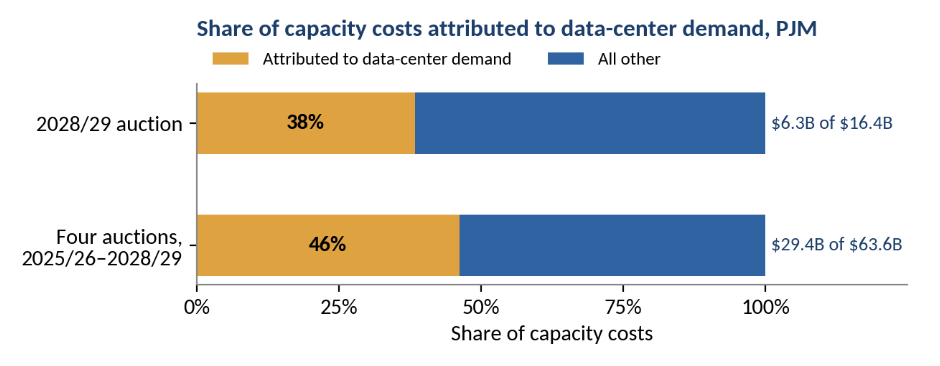
- Data centers are the main source of new demand, and they are raising prices. PJM attributed most of its latest forecast increase to large new users, mainly data centers. Its independent market monitor estimates that data-center demand accounts for 38 percent of 2028/29 capacity (standby-power) costs.1, 2
- A price cap is holding costs down but cannot end the shortage. Without the cap, prices in the latest auction would have been about 60 percent higher, and the grid would still have fallen short.1
- Local costs are real but mostly unmeasured. Water, air quality, noise and land costs depend on agreements and permits that are rarely made public in full.
How the electricity system works
Household electricity is part of a much larger system. Power plants across the region, most of them privately owned, produce it while a network of high-voltage transmission lines, known as the grid, carries it long distances. Only at the last step do local utilities deliver it over neighborhood wires. The grid serving Greater Philadelphia is operated by PJM Interconnection for 13 states and Washington, D.C.
What is a data center?
A data center is a building, or campus of buildings, filled with computer servers that store data and run websites, cloud services and artificial intelligence; the familiar term “server farm” describes the same thing. Servers run around the clock and produce heat, so data centers also need large cooling systems and backup generators to keep running during outages. They range from a single room inside an office building to campuses of several buildings. Even a small one is power-hungry: federal survey data show that office buildings containing data centers use up to 87 percent more electricity per square foot than similar offices without them.3 The new campuses are on a different scale. The International Energy Agency estimates that a typical AI-focused data center uses as much electricity as 100,000 households, comparable to heavy industry such as an aluminum smelter, and that the largest now under construction will use 20 times as much.4
Who runs what
PJM plans and operates the grid and runs its wholesale markets. The Federal Energy Regulatory Commission (FERC), an independent federal agency, regulates wholesale electricity markets and interstate transmission; it must approve PJM’s market rules, including the price cap described below. State utility commissions, such as the Pennsylvania Public Utility Commission, regulate what local utilities charge for delivery and how they buy power for customers who do not choose another supplier.
How the grid buys power for the hottest days
PJM buys electricity throughout each day in its energy market. Separately, in its capacity market, it pays power plants in advance to promise they will be available when demand peaks, on the hottest summer afternoons. That standby-power market is where data centers have had their clearest effect, and it is the focus of this brief. Capacity costs appear in the supply portion of every customer’s bill, whether the customer buys from the utility or a competing supplier, with a lag as purchase contracts roll over.
Key terms
Capacity auction. PJM’s yearly auction to buy promises from power plants (and from customers willing to cut use on request) to be available during a future year’s peak. Recent auctions have been held one to two years ahead.
Unforced capacity (UCAP). The amount of power a resource can reliably be counted on to supply at peak, after allowing for breakdowns, weather and other limits. A plant that can produce 100 megawatts but is sometimes unavailable might count as, say, 80 megawatts of UCAP. Both what PJM needs and what it buys are measured this way.
Reliability requirement. The total UCAP PJM aims to buy: forecast peak demand plus a safety cushion, called the reserve margin, of about 20 percent, so that the lights stay on if plants fail or demand runs higher than expected.
Cleared capacity. The amount PJM actually buys. Plants submit offers; PJM accepts the cheapest until it meets the requirement or runs out of offers.
Clearing price. The single price, in dollars per megawatt-day, paid to every accepted offer. A megawatt-day is the cost of keeping one megawatt available for one day.
Shortfall. The gap when cleared capacity falls below the reliability requirement.
Price cap. A ceiling on the clearing price, however short supply is. FERC approved one for recent auctions to limit costs to customers.
Data centers enter this system as forecast demand. When PJM expects more demand on its peak days, the reliability requirement rises, PJM must buy more UCAP, and it has to accept more expensive offers to get it. That raises the clearing price paid to all plants, and the cost flows to every customer in the market.
The regional cost
Demand is growing faster than supply
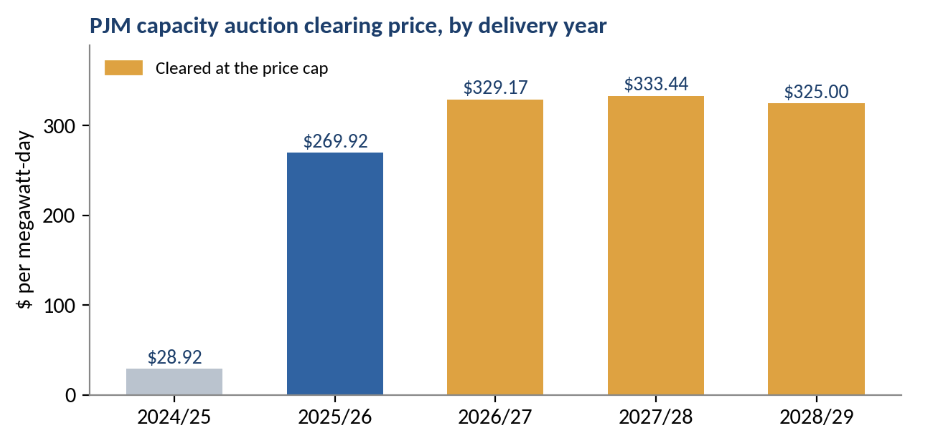
For years, the capacity auction had plenty of offers and prices stayed low, under $30 per megawatt-day for the year starting June 2024. Then large data centers began entering PJM’s demand forecasts. For the year starting June 2027, PJM raised its forecast of peak demand by 5,250 megawatts, about the output of five large nuclear reactors, and said the increase was "largely due to additional Large Loads." As a result, the reliability requirement rose by 6,295 megawatts of UCAP. Cleared capacity rose by only 371 megawatts. PJM ended up about 6,600 megawatts short, with a reserve margin of 14.9 percent instead of 20 percent.1
What the price cap does, and does not do
When supply is tight, the clearing price can climb very high. To protect customers, FERC approved a price cap of about $330 per megawatt-day, and every auction since 2026/27 has cleared at that ceiling.1, 5 The cap has saved money: PJM estimates that without it, the 2027/28 clearing price would have been $529.80 and total costs about $9.9 billion higher.1
But a price limit does not create more power. PJM’s own test shows that even without the cap, cleared capacity would have reached a reserve margin of only 15.4 percent, still well short of 20 percent.1 The main obstacle is how slowly new power plants can be built and connected. Over the longer run, the cap could also discourage some new investment, because it sits below what PJM estimates a new power plant in this part of the grid needs to earn.6 How much that matters is not yet known.
How much is due to data centers
PJM’s independent market monitor estimates the data-center share by asking what the auctions would have cost without data-center demand. Its answer: $6.3 billion of the $16.4 billion in capacity costs for 2028/29, or 38 percent, and 46 percent across the last four auctions.2 It also estimates that data-center demand made wholesale electricity about 9 percent more expensive in the first seven months of 2026.7 These are estimates from a model, not amounts on anyone’s bill, and they include data centers that are planned but not yet built.
To give a sense of scale for the region: PECO’s service area accounts for about 5 percent of PJM’s peak demand.8 Applying that share to the market monitor’s estimate gives roughly $330 million for 2028/29. That is a rough illustration, not a measured increase in bills. What PECO customers actually pay depends on how power is bought and how costs are divided among customers. PECO’s June 2026 rate change added about $4.94 a month for a typical home, but PECO did not say how much of that was due to data centers.9
Why the region pays even without local data centers
Everyone on the PJM grid buys power in the same market. A data center in Virginia raises the price paid in Philadelphia much as one in Bucks County would. New Jersey’s governor made the same point when signing a data-center law in July 2026.10 That means a township’s decision to approve or reject a project barely changes the region’s electricity costs. Those costs are shaped mainly by PJM, federal regulators and the states acting together.
Beyond the power market: costs at the site
Other costs arise where data centers are built. They are paid by different people and fall under different authorities, so they should not simply be added to the regional cost: part of a higher electricity payment is income to power producers, while a harm such as noise appears on no bill at all.
| Cost | Example | Who could end up paying | Who decides | Measured? |
|---|---|---|---|---|
| Electricity market | 38% of 2028/29 capacity costs attributed to data centers | All customers on the PJM grid | PJM, FERC and the states | Modeled |
| Grid connections | New substations and lines for Falls Township and East Whiteland | Other customers, if usage falls short and guarantees do not cover costs | State utility commissions and utilities; FERC for some agreements | No |
| Water | Falls Township campus: up to 4.4 million gallons a day at peak | Other water users, if public systems must expand | Water providers; Delaware River Basin Commission for large withdrawals | No |
| Air and noise | Falls Township application for 283 backup engines | Nearby residents | State air regulators; township ordinances | No |
| Land | Limerick campus: about 191 acres | The community, if the land had better uses | Township zoning | No |
| State tax break | $188.4 million projected for FY2026–27 | State taxpayers and other state programs | General Assembly and governor | Projected |
Sources: PJM market monitor; PECO testimony reported by WHYY; FERC; Falls Township; Delaware River Basin Commission; Limerick Township; Pennsylvania Department of Revenue.2, 11, 12, 13, 14, 15, 16
Projects in the region
Most of the region’s projects are not yet operating. As of March 2026, the regional planning commission counted 20 existing and seven proposed data centers in its nine-county area.17 The four projects below have the most detailed public records.
Amazon campus Under construction Falls Township, Bucks County, PA Peak water need estimated at up to 4.4 million gallons a day.13 Application pending for 280 natural-gas and 3 diesel backup engines.13 Site is a Keystone Opportunity Investment Zone through December 2035.18 | Sentinel/Green Fig Approved · Work paused East Whiteland Township, Chester County, PA Work stopped in August pending water-supply documentation.19 Signed water-supply agreement posted October 7; no further building permits as of October 6.20 | |
Limerick campus Proposed Limerick Township, Montgomery County, PA About 2.8 million square feet on about 191 acres.15 First phase lists about 36 generators and 42 rooftop chillers; hearings ongoing.15 | Project Washington Blocked Delaware City, New Castle County, DE Proposed 1.2-gigawatt campus.21 Found barred under Delaware’s Coastal Zone Act in February 2026, largely because of its backup generators; appeal withdrawn in August.21 | |
Protections against these costs exist but are uneven. PECO says it holds a ten-year financial guarantee from developers, though a federal regulator questioned whether the Amazon guarantee covers all the grid upgrades the project could trigger.11, 12 Pennsylvania, New Jersey and Delaware all moved in 2026 to make large power users pay for the grid equipment they need.10, 22, 23 No public source puts a dollar value on the water, air, noise or land costs at any of these sites.
The state’s tax break
Pennsylvania exempts data-center equipment from its 6 percent sales tax. The state projects this will cost $188.4 million in lost revenue in fiscal 2026–27, rising to $517.2 million by 2030–31.16 Lawmakers voted to repeal it in June, but the final budget kept it; the governor now requires companies that use it to meet new state standards.24, 25 The key unanswered question is whether the tax break changes where data centers locate, or mostly rewards investment that would have come anyway. We found no Pennsylvania study that measures it.
What it means and what to watch
The evidence is clearest on the regional cost. The grid is short of standby power, data-center demand is the main reason its requirement has risen, and the market monitor attributes over a third of recent capacity costs to that demand. A price cap is limiting how much of this reaches customers, but it cannot add supply, and even without it the grid would have fallen short. Because the market is shared, these costs reach Greater Philadelphia largely regardless of where data centers are built.
The evidence is weakest on local costs. Water, air quality, noise and land costs are real but depend on agreements and permits, and the public record does not yet allow them to be measured. Nor does it show how much of the regional cost has reached household bills so far. The following indicators will show whether pressure on the region is easing or growing.
| Signs pressure is easing | Signs pressure is intensifying |
|---|---|
| Next auction. The 2029/30 auction clears below the cap with no shortfall. | Growing shortfalls. The gap below PJM’s target widens from one auction to the next. |
| Supply growth. The power PJM secures grows as fast as its target. | Who pays to close the gap. The cost of PJM’s separate emergency purchase is spread across all customers rather than the large users that created the need.26 |
| Forecast vetting. PJM keeps removing speculative data-center requests from its forecasts. | Regional price gaps. The eastern part of the grid, including Greater Philadelphia, begins to clear at higher prices than the rest. |
| New supply on time. Additions such as the 890 megawatts of nuclear upgrades announced by Google and Constellation arrive on schedule, starting in 2028.27 | Uncovered upgrades. Utilities build grid upgrades for data centers without guarantees that cover their full cost. |
For Greater Philadelphia, the indicator to watch is the gap between the demand the grid expects and the reliable supply it can secure. While that gap persists, data-center growth will shape the region’s electricity costs, whatever its own townships decide.
The measurement gap
No public source reports how much data-center demand utilities have actually contracted to serve, in megawatts and connection dates, by county or utility area. Regular reporting by PECO, PSE&G, Atlantic City Electric and Delmarva Power would show how much of the region’s projected demand is firm rather than speculative, the single most useful piece of information missing from this brief.
Reference table
Every figure used in this brief, with geography and period. Note numbers correspond to the sources that follow.
| Indicator | Value | Geography | Period | Note |
|---|---|---|---|---|
| Increase in forecast peak demand | 5,250 MW | PJM | 2027/28 vs. 2026/27 | 1 |
| Increase in reliability requirement vs. cleared capacity (UCAP) | +6,295 MW vs. +371 MW | PJM | 2027/28 vs. 2026/27 | 1 |
| Reserve margin secured vs. target | 14.9% vs. 20% | PJM | 2027/28 | 1 |
| Reserve margin in no-cap simulation | 15.4% | PJM | 2027/28 | 1 |
| Clearing price (cap) / simulated without cap | $333.44 / $529.80 per MW-day | PJM | 2027/28 | 1 |
| Capacity costs attributed to data centers | $6.3B of $16.4B (38%) | PJM | 2028/29 | 2 |
| Capacity costs attributed to data centers | 46% | PJM | 2025/26–2028/29 | 2 |
| Wholesale cost effect of data-center demand | ≈9% | PJM | Jan.–Jul. 2026 | 7 |
| Illustrative allocation of attributed capacity costs | ≈$330 million | PECO area | 2028/29 (ELGP calculation) | 8, 2 |
| Residential bill change at 700 kWh | +$4.94/month (3.1%) | PECO service area | June 2026 | 9 |
| Data centers, existing / proposed | 20 / 7 | DVRPC nine-county region | March 2026 | 17 |
| Sales tax exemption, projected cost | $188.4M / $517.2M | Pennsylvania | FY2026–27 / FY2030–31 | 16 |
| Peak water need, Amazon campus | 4.4 million gal/day | Falls Township, Bucks County | Estimate, July 2026 | 13 |
Notes
- 1. PJM Interconnection. 2027/2028 Base Residual Auction Report. December 17, 2025, including the no-cap simulation in the Appendix. Geography: PJM footprint.
- 2. Monitoring Analytics, independent market monitor for PJM. Market Monitor Report, Members Committee webinar. July 27, 2026; capacity-market attribution. Geography: PJM footprint.
- 3. U.S. Energy Information Administration. Office buildings with data centers use significantly more electricity than other offices. Today in Energy, October 2016; Commercial Buildings Energy Consumption Survey. Geography: United States.
- 4. International Energy Agency. Energy and AI: Executive Summary. April 2025. Geography: Global and United States.
- 5. PJM Interconnection, Inside Lines. PJM Capacity Auction Procures 138,318 MW of Generation Resources. July 2026; 2028/29 Base Residual Auction. Geography: PJM footprint.
- 6. PJM Interconnection. 2027/2028 RPM Base Residual Auction Planning Period Parameters. August 26, 2025. Geography: PJM footprint.
- 7. Monitoring Analytics, independent market monitor for PJM. Market Monitor Report. August 19, 2026; slides 26–29. Geography: PJM footprint (13 states and D.C.).
- 8. PJM Interconnection. Summer 2025 Weather Normalized RTO Coincident Peaks. Revised November 14, 2025. Geography: PJM footprint and transmission zones.
- 9. PECO statement published by East Whiteland Township. PJM Market Prices Drive PECO Customer Bills 3 Percent Higher Just Before Summer Months. May 26, 2026; change effective June 1, 2026. Geography: PECO service territory.
- 10. New Jersey Monitor. Sherrill signs three bills to lower NJ electricity costs. July 7, 2026. Geography: New Jersey; PJM.
- 11. Sophia Schmidt, WHYY. PECO signs agreements with data centers requiring them to pay for their own grid upgrades. May 13, 2026. Geography: PECO service territory.
- 12. FERC Commissioner Judy Chang. Concurrence on the PECO–Amazon Transmission Security Agreement. November 21, 2025; ER25-3492. Geography: PECO service territory.
- 13. Falls Township. Data Center Opponents Speak Out Against Falls Site. July 15, 2026; account of July 14 town hall. Geography: Falls Township, Bucks County, PA.
- 14. Delaware River Basin Commission. Data Centers Frequently Asked Questions. Accessed October 8, 2026; pp. 1–2 and 4–5. Geography: Delaware River Basin.
- 15. Limerick Township. Conditional Use Hearings. Current project descriptions; scheduled continuation October 1, 2026; accessed October 8, 2026. Geography: Limerick Township, Montgomery County, PA.
- 16. Pennsylvania Department of Revenue. 2026–27 Tax Expenditure Analysis. February 2026; printed p. 51, PDF p. 53. Geography: Pennsylvania, statewide.
- 17. DVRPC. Understanding Data Centers, Municipal Implementation Tool 37. June 2026; inventory as of March 2026; pp. 8–9. Geography: DVRPC nine-county region.
- 18. LevittownNow. Revised Plans Include Tech Buildings At Keystone Trade Center. March 27, 2025. Geography: Falls Township, Bucks County, PA.
- 19. Brooke Schultz, The Philadelphia Inquirer. The controversial East Whiteland data center project has been issued its second stop-work order. August 27, 2026. Geography: East Whiteland Township, Chester County, PA.
- 20. East Whiteland Township. Sentinel Green Fig Data Center on Swedesford Road. Updates October 6–7, 2026. Geography: East Whiteland Township, Chester County, PA.
- 21. Spotlight Delaware. Project Washington pulls appeal, data center won’t proceed under current plan. August 28, 2026. Geography: New Castle County, DE.
- 22. Pennsylvania Public Utility Commission. Interconnection and Tariffs for Large Load Customers, Final Order and Model Tariff, M-2025-3054271. Adopted April 30; entered May 12, 2026; 56 Pa.B. 3271. Geography: Pennsylvania.
- 23. Spotlight Delaware. Delaware General Assembly roundup: Energy and data centers. July 16, 2026. Geography: Delaware.
- 24. Spotlight PA, via WITF. Lawmakers up transparency for data centers, leave $2B tax exemption untouched in Pa. budget. July 21, 2026. Geography: Pennsylvania.
- 25. Commonwealth of Pennsylvania. Executive Order 2026-05, Protecting Pennsylvania Consumers from Data Center Impacts. August 18, 2026; 56 Pa.B. 5898. Geography: Pennsylvania.
- 26. PJM Interconnection, Inside Lines. FERC Accepts PJM Reliability Backstop Proposal. 2026. Geography: PJM footprint.
- 27. Constellation Energy. Google and Constellation agreement to bring 890 MW of new nuclear capacity to PJM. October 6, 2026; company announcement. Geography: PJM footprint.

