Philadelphia’s FY2027 Budget: New Commitments, Household Tradeoffs, and a Thinner Fiscal Cushion

By Saloni Tandon, Director of Research & Analytics
Edited by Jeff Hornstein, Executive Director
March 24, 2026
Philadelphia’s proposed FY2027 budget marks a turning point. For several years, the city’s finances were shaped by an unusual combination of federal relief, strong tax collections, and vacancy-driven underspending that produced larger year-end fund balances than the city’s underlying fiscal structure could sustain. That period is ending. The proposed FY2027 budget continues to fund core services and advances major priorities in housing, public safety, wellness, homelessness response, education, and economic mobility. However, it does so with substantially less margin for error. The result is a transition budget: one that reveals what Philadelphia can support from its own revenue base, what new commitments the administration is choosing to make, and where households may begin to experience the tradeoffs more directly.
The Economy League has reviewed Philadelphia’s recent Five Year Plans to place the proposed FY2027 budget in longer-term context and assess how the city’s fiscal posture is changing. Our full analysis examines major revenue and expenditure trends, reserve drawdown, staffing dynamics, debt and pension pressures, and the household implications of new taxes and spending choices.
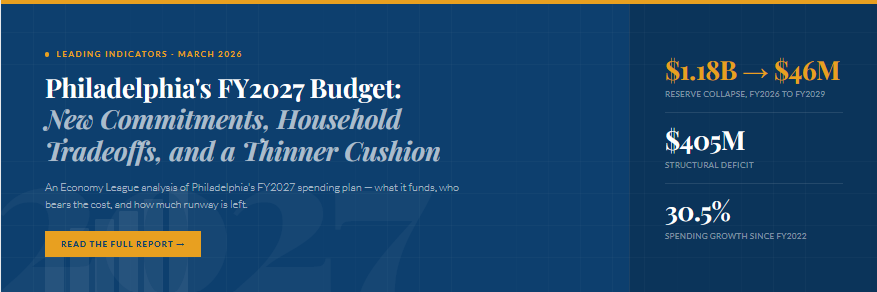
About the 'Budget Analysis Dashboard': A city budget is ultimately a set of choices made visible - about what to fund, what to defer, and what tradeoffs to accept. But those choices are rarely legible from the headline numbers alone. The Economy League's Philadelphia Budget Dashboard is designed to make the underlying structure of those decisions transparent. Drawing on four successive Council-approved Five-Year Financial Plans, it tracks how revenue sources are shifting, how spending is distributed across categories and departments, how the reserve cushion has built and is now contracting, and how the administration's own projections have been revised over time.
To use: Select a tab to navigate between topics; hover any chart element for the source figure; read the annotation beneath each chart for analytical context. The goal is not to reach conclusions on behalf of the reader, but to put the relevant data in one place so that the fiscal position of the city, and the choices embedded in it, can be examined directly.
What follows below is an abridged summary of the Economy League's full FY2027 budget analysis. Readers seeking the underlying data and extended analysis are encouraged to consult the full report alongside the above shared Budget Dashboard.
What You Need to Know
- FY2027 is the first operating budget after the post-pandemic relief period. Philadelphia is transitioning from a period supported by American Rescue Plan Act funds and vacancy-driven underspending into one that relies primarily on recurring tax revenue and intergovernmental support. The city moves from an adjusted surplus in FY2025 to a planned adjusted deficit in FY2027, with reserves used to close the gap.
- The budget remains ambitious, but the cushion is narrowing. The city continues to fund visible priorities, yet the fund balance available for appropriation falls sharply over the plan period. FY2027 is workable, but leaves limited flexibility if labor, healthcare, or revenue assumptions shift.
- Housing is one of the most operationalized priorities in the plan. The H.O.M.E. agenda is supported by major borrowing authority, new housing investments, and named delivery mechanisms tied to repair, preservation, mortgage access, and neighborhood stabilization.
- Economic mobility is more substantively developed than a single budget line suggests. The administration uses Economic GPS as a broader framework for workforce access, financial empowerment, business support, and household mobility, though the full public accounting of all stimulus-related allocations remains incomplete.
- Some of the tradeoffs will be felt directly by residents. The proposed rideshare tax and retail delivery tax are narrower than broad-based tax increases, but they affect recurring household transactions. Some residents may face higher costs even in a budget that seeks to protect affordability in other areas. (Note: Since the budget's presentation, Mayor Parker has proposed raising the ride-hail tax to $1.00 per ride to address the School District's separate $300 million deficit — see Section 4.)
- The most significant structural cost pressure is healthcare, not pensions. Pension costs remain a substantial obligation, but health and medical insurance is the clearest long-run expenditure driver in the plan, rising faster and more consistently than most other major spending lines.
1. The First Budget After the Windfall Years
Philadelphia’s FY2027 budget is best understood as the city’s first clear look at its post-ARPA operating baseline. The proposed plan totals roughly $6.97 billion and continues to fund the administration’s key priorities across safety, housing, economic opportunity, education, and neighborhood quality of life. The larger fiscal story, however, is that the temporary cushion that helped stabilize the city in recent years is fading. Federal COVID relief is no longer available to support operations at the same scale, and the city’s capacity to absorb shocks is diminishing.
You can view the full screen version of the sankey chart here
That matters because the recent period of fiscal strength was real but not entirely structural. Philadelphia ended FY2025 with a historically large fund balance after several years in which one-time federal support and vacancy-driven underspending improved year-end outcomes. In FY2024 and FY2025, actual obligations came in well below projections, in part because thousands of budgeted positions remained unfilled. As hiring improves, that effect disappears.
The longer trend is the more consequential one. Since FY2022, city obligations have grown much faster than General Fund revenue. The budget is larger, but much of that growth reflects the cost of running government in a more expensive environment rather than a broad-based expansion of discretionary capacity. FY2027 matters not because of an immediate fiscal crisis, but because the budget now reveals more clearly what Philadelphia can and cannot sustain without extraordinary external support.
2. The Administration Continues to Advance Visible Priorities
A tighter budget is not the same as a stripped-down one. The proposed plan advances a number of high-visibility initiatives, and in several cases the administration has moved from broad framing into more concrete program design.
i. Housing: H.O.M.E. is framed as a 30,000-unit build-and-preserve strategy, supported by previously authorized borrowing, additional planned borrowing, and new investments in programs for repair, preservation, tangled title resolution, eviction diversion, rental inspection, and homeownership access. The initiative names programs, delivery channels, and implementation milestones, making it one of the most fully developed policy areas in the plan.
ii. Economic Mobility: Economic GPS is presented as an organizing framework for growth, prosperity, and security, backed by operating and capital commitments tied to workforce access, career-connected learning, vendor-support technology, and financial empowerment. The broader shift is notable: the city is framing economic development not only as firm attraction, but also as household mobility and access.
iii. Homelessness Response and Wellness Infrastructure: The plan includes new support for shelter expansion, wraparound services, extended Hub of Hope operations, and added encampment response capacity, alongside multi-year operating support for the city’s wellness ecosystem. These additions indicate that systems once treated episodically are being built into a more permanent care-and-recovery framework.
iv. Education: The annual General Fund contribution to the School District remains relatively stable. The budget also includes new education investments, additional Pre-K capacity, extended-day and extended-year programming, and added support for the Community College of Philadelphia. Education is being maintained and supplemented, even if it is not the most visibly expanding line in the plan.
3. Fixed and Rising Costs Absorb Most of the Budget’s Growth
On paper, the city is proposing a larger budget than in prior years. In practice, much of that increase is absorbed by labor, benefits, contractual services, and debt. Personnel-related spending alone consumes the majority of the budget, and a large share of the remaining growth is tied to obligations that are fixed, contractual, or politically durable. The city’s room to maneuver is narrower than the topline figure suggests.
The most significant structural cost trend is healthcare. Pension costs remain substantial, and the city still faces a known pension obligation bond balloon payment in FY2029 that has not yet been fully addressed in the plan. The more persistent upward pressure, however, comes from health and medical insurance, which rises steadily across the plan period. Healthcare inflation is difficult to offset in other categories; even with restraint elsewhere, this line continues to expand.
The staffing picture adds another dimension. Vacancy rates have fallen, and several departments have added filled positions, an improvement that should benefit residents. However, better staffing also makes the structural deficit more apparent. When positions go unfilled, salary dollars go unspent and year-end balances appear healthier. As the city fills those roles, that effect fades. Operational improvement and budget constraint can move in the same direction at the same time.
4. Some Tradeoffs Will Be Felt Directly by Residents
The proposed budget does not rely on broad-based tax increases. It does include targeted measures, however, that could affect everyday household costs.
One is a proposed $0.25 retail delivery tax on certain goods delivered within Philadelphia, with exemptions for food, drugs, medical devices, baby products, and wholesale goods. Another is a proposed $0.20 tax on rideshare trips originating in the city. These are narrower than across-the-board tax increases, but they affect recurring household transactions.
Update, March 23: Since the budget's presentation, Mayor Parker has proposed increasing the ride-hail tax to $1.00 per ride — five times the original figure — with the additional revenue directed specifically to the School District's $300 million structural deficit. At $1.00 per ride, the tax is projected to raise $48 million annually for the District beginning in FY2028, and $24 million in FY2027 if passed with an accelerated January 1 effective date.
The rideshare tax carries particular significance from an affordability standpoint. It comes at a moment when SEPTA remains under financial strain and when many residents face ongoing transportation constraints. For households with limited access to private vehicles, unreliable transit schedules, or irregular work schedules, rideshare often functions as a necessary last-mile option rather than a discretionary one. A new per-trip charge adds cost to a mode that a meaningful share of residents depend on.
The revenues from these measures are dedicated to public purposes, including road improvements and school funding. The tradeoffs are nonetheless real: costs are being shifted onto specific forms of everyday activity, and that burden will fall unevenly across income levels and geographies.
5. The Strategic Question Is Whether Stabilization Translates to Durability
Philadelphia’s FY2027 budget is stable in the near term but more constrained over the plan period. The city still holds reserves; the housing strategy is more operationally developed than most comparable municipal plans; economic mobility programming is substantively designed rather than aspirational; staffing is improving; and education funding is being protected. These reflect genuine institutional capacity.
At the same time, the federal cushion has largely been drawn down, healthcare costs continue to rise above the rate of revenue growth, several new revenue measures will reach households more directly than budget language may convey, and the reserve runway narrows meaningfully over the next several years.
Underlying all of this is a demographic and economic baseline assumption: that a city with modest job growth, a fragile population recovery, and persistent household strain can generate sufficient recurring revenue to sustain major programmatic commitments. That assumption may prove correct, but it is also the primary source of fiscal vulnerability in the plan.
The near-term picture is one of narrower choices rather than collapse. For residents, the question is whether visible improvements in housing, safety, wellness, and public services will outweigh the continued fragility of household affordability. For policymakers, the question is whether Philadelphia can translate a workable one-year budget into a more durable fiscal model, one that protects services and competitiveness without relying on a steadily thinning reserve cushion in each successive year.


