TCB July 2026

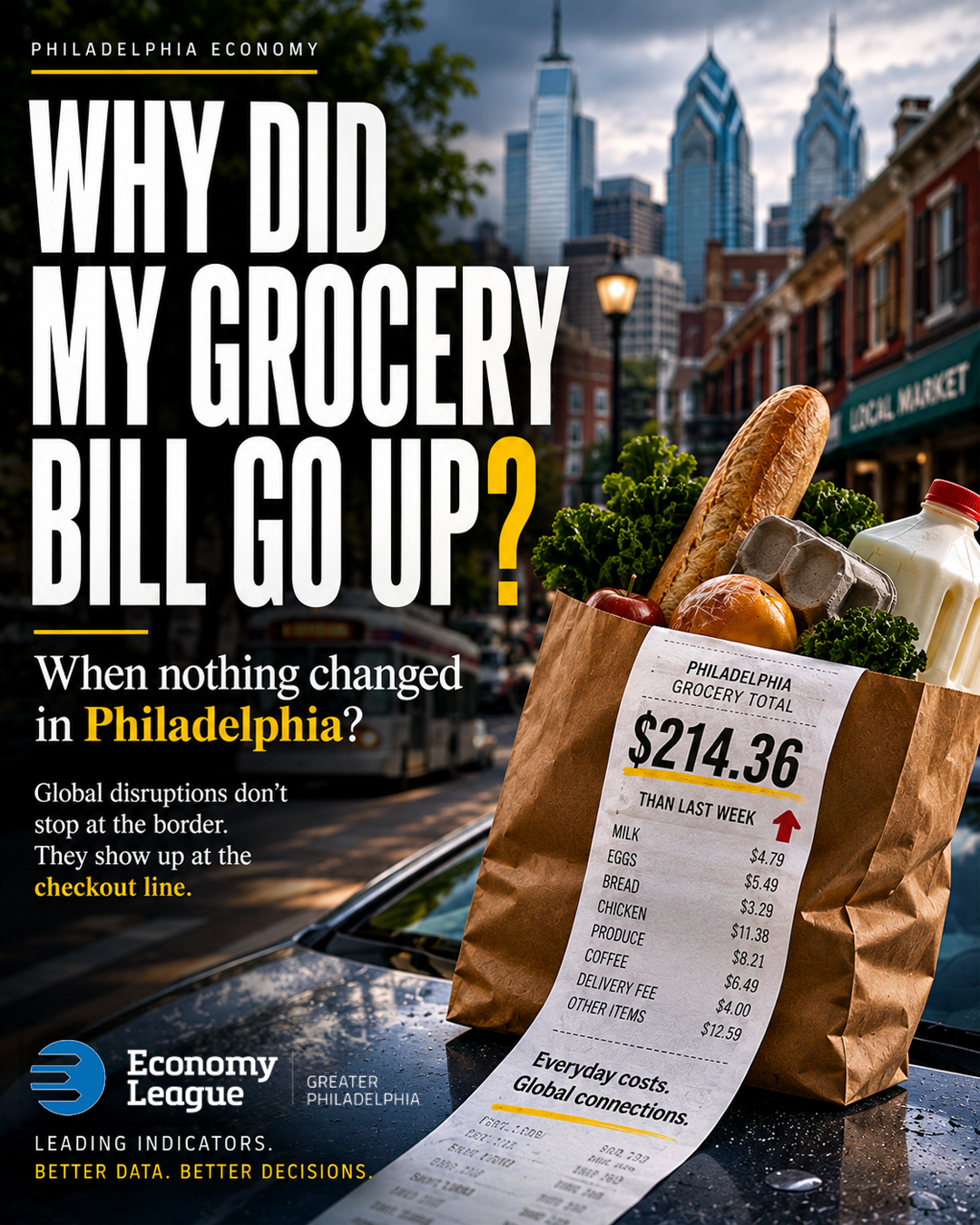
Why Did My Grocery Bill Go Up in Philadelphia?
By Jeff Hornstein, PhD, Executive Director
Economy League of Greater Philadelphia
If affordability is the defining public concern of this moment, then few places do Philadelphians feel it more immediately than at the grocery store.
The question I hear, in one form or another, is simple: Why does the same cart cost so much more than it used to? The answer, unfortunately, is also simple: this is not one problem. It is several problems compounding at once.
Your grocery bill in Philadelphia has likely gone up because local inflation has been running hotter than national projections, because external costs like fuel and tariffs raise the cost of moving and stocking food, and because many families have lost the pandemic-era supports that once helped absorb those increases. In other words, the problem is not just prices. It is the interaction between prices, wages, and the disappearance of cushions that once kept families afloat.
The regional inflation numbers tell us the first part of the story. The latest Bureau of Labor Statistics data for the Philadelphia-Camden-Wilmington region show a 4.8% year-over-year increase in the Consumer Price Index. That is materially higher than the Federal Reserve Bank of Philadelphia’s first-quarter 2026 projection for national headline CPI inflation of 2.6%. That gap matters. It tells us that even if inflation is cooling nationally on paper, Philadelphia households are still experiencing a much sharper cost-of-living reality on the ground. BLS Philadelphia Fed
And groceries are where that reality becomes visible.
Food prices are especially sensitive to the external costs that run through the whole economy. Rising fuel prices increase the cost of moving food from farms to processors, from processors to distribution centers, and from distribution centers to local stores. The Associated Press reported that higher fuel prices are already pushing up transportation and packaging costs, with obvious implications for groceries and other necessities. The Philadelphia Inquirer At the same time, rising tariffs and higher costs for everyday items are acting as a drag on the broader economy, especially for households in the lower third of the income distribution. Metro Philadelphia
This is how inflation actually works in people’s lives. It does not arrive as a neat statistic. It arrives as a series of pass-through costs. The truck costs more to fuel. The wholesaler pays more to move inventory. The store pays more to keep shelves stocked and refrigerators running. Eventually, the shopper pays more at checkout.
But there is a second layer to this problem, and it is just as important: many families are now absorbing these higher food costs without the supports that temporarily reduced hardship during the pandemic. Philadelphia’s Community Needs Assessment is explicit about this. Enhanced SNAP benefits and other pandemic-era supports significantly reduced poverty when they were in place. Once those programs expired, poverty rose again. The report describes that rebound clearly and warns that when such supports are not sustained, household instability returns quickly. City of Philadelphia
That matters enormously for grocery bills, because food is the most basic nonnegotiable purchase a household makes. When extra SNAP support disappears, the food budget does not disappear with it. It simply shifts back onto families already stretched by housing, utilities, and transportation.
And Philadelphia is stretched. The same Community Needs Assessment reports that families in poverty in Philadelphia face an aggregate income deficit of $716.2 million — the amount they would need just to reach the poverty line. The report also makes clear that extremely cost-burdened households are often forced into real sacrifices involving food, medicine, and utilities simply to stay housed. City of Philadelphia
That is the deeper point here. A rising grocery bill is not only about food. It is about the broader affordability stack.
Philadelphia’s own fiscal documents describe inflation as one of several major “external pressures” shaping a more uncertain outlook, alongside labor-market tightness and the end of pandemic-era federal relief. City of Philadelphia FY2026 Budget in Brief At the same time, the city is experiencing real economic momentum. Center City visitor volumes topped 200,000 average daily visitors in 2025, and the Pennsylvania Convention Center hosted more than 906,000 attendees, with more than 1 million projected in 2026. NBC10 Philadelphia Local tourism analysts also expect hotel occupancy to rise 2.8%. Metro Philadelphia
That momentum is welcome. But it does not automatically translate into relief at the checkout line. In fact, when local demand is strong while housing, transportation, and utility costs remain elevated, the result can be a K-shaped economy in which visible growth coexists with very real household strain. Metro Philadelphia
So what should we do?
First, we should treat food affordability as part of economic policy, not charity. That means maximizing enrollment in SNAP, WIC, school nutrition, and utility-assistance programs so families are not leaving support on the table. Second, we need to reduce the nonfood costs that make food insecurity worse — especially housing, transportation, and energy. Third, we should strengthen regional supply resilience, including local and regional food distribution systems, so food prices are less exposed to distant shocks. And finally, we need to measure affordability honestly. If national inflation is projected at 2.6% while Philadelphia households are living through 4.8%, then local decision-making must start with local reality. Philadelphia Fed BLS
Why did your grocery bill go up in Philadelphia?
Because the cost of living here is rising faster than the headline suggests, because food carries the weight of fuel and freight and broader inflation, and because too many families are navigating these increases without the supports that once softened the blow.
The bigger question is whether we are prepared to respond to affordability as the structural challenge it has become.
Jeff Hornstein, PhD
Executive Director
Economy League of Greater Philadelphia
The Economy League of Greater Philadelphia is a nonpartisan nonprofit organization that conducts research and facilitates collaborative action on the region’s most pressing economic challenges.