TCB November 2026

The Lesson(s) of 11/3/2026: Let's Make America Boring (and Functional) Again
Executive Director, Economy League of Greater Philadelphia
By the time I fell asleep very late on Tuesday November 3, 2026, one thing was clear: voters across the US had clearly and decisively rejected the policies and politics that have defined most of the past decade and delivered a commanding victory to moderates centered, at least for the moment, in the Democratic Party. Not only did registered Democrats turn out in huge numbers, but more importantly, independent voters swung decisively away from the GOP, in nearly every corner of the country. The biggest shock to me, as a former union political director who worked the PA statehouse for 7 years, was the decisive shift in my home state, Pennsylvania, delivering the coveted ‘trifecta’ to the Democrats for the first time in decades.
It was, in my view, a sweeping mandate not for a particular political party per se, but for the pragmatism that has, for much of the last 250 years, made America the envy of the world. I am cautiously optimistic that the meaningmakers and wayfinders, the Problem Solvers, are back in charge, at least for the moment. The Economy League was born during a similar moment in the early 20th century, when the Progressives swept into power in response to Gilded Age excess and corruption coupled with mind-numbing technological change. For early 20th century reformers, “progress” meant harnessing the new “dismal science” of economics, specifically the tools of statistics, to create what we now call data-driven approaches to solving big problems, all in the quest of what historian Robert Wiebe called “the search for order.” The Economy League has produced a steady stream of actionable intelligence for nearly 120 years; I am hopeful that once again good ideas shall hold sway with lawmakers from DC to Harrisburg, Trenton, and Dover, as well as further down the federalist political food chain, and that good policy and effective governance will once again be the priority and the sine qua non of good politics.
So, channeling my predecessors, with the unified state government in PA that surprisingly emerged providing an opportunity, I want to make the case for regionalism, for the privileging of markets over maps, as a path out of the Raj Chetty social mobility basement and toward the building of a truly Greater Philadelphia.
Pay Much More Attention to Markets than Maps
If there is any lesson of 11/3/26, it is that lines of difference need to be bridged. When ruby red Iowa or Kansas or Lancaster County shifts decisively “blue,” especially in such a transformative and unsettling moment for the global economy, the message to me is clear: they are craving what we at the Economy League call collaboration across lines of difference. They are looking toward elected officials to focus on harnessing and shaping the potent market forces that have been unleashed by the last few decades of lightning-fast technological change, the rise of the digital “knowledge” economy that is no longer rooted in place – except when it necessarily is, such as in education, health, and human services, as well as real estate and construction. Ordinary Americans have been buffeted by powerful winds of change for a few decades and the time is ripe for a politics of forward-looking change management, not backward-looking revanchism and finger-pointing.
Yet too much governance in the past few decades has been driven by states – most of which are not even remotely coterminous with a labor or consumer market – competing with each other to “win” corporate headquarters or manufacturing plants with lucrative tax incentive packages that amount to beggar-thy-neighbor political decisions rather than market-driven economic development policy.
While the federalist system of layered government was designed to avoid aggregation of unaccountable power, in practice in recent years this has meant governance that is weak and ineffective at market-based problem-solving: the structure of political incentives is grossly misaligned with the prerogatives of modern capitalism. Now is the time to begin to rethink federalism and elevate market-based regionalism. Here at home this means creating formal and informal structures of collaboration across southern New Jersey, northern Delaware, and eastern PA from the Lehigh Valley down to DelCo. The Greater Philadelphia Growth Partnership represents a strong step in the right direction, but it must cross - and transcend - state boundaries if it is to be truly impactful.
The focus on 17th century lines on maps must be replaced with 21st century market analytics.
The focus on 17th century lines on maps must be replaced with 21st century market analytics and policies that put representatives of the Wilmington entrepreneur, the Camden worker, and the (increasingly regionalized) Philadelphia healthcare system in the same rooms to craft regional economic strategy. It is time to jettison states as “laboratories of democracy,” the quaint 20th century formulation that held when companies and industries were smaller than the governments that sought to regulate them, in favor of a new regionalism that redraws the political map in ways that align much more closely with labor and consumer markets, the smallest units of analysis for capitalism.
The Economy League intends to work with other ecosystem partners and use the convening power of our Greater Philadelphia Leadership Exchange (aka “GPLEX”) to pull together cross-sector regional leaders and discuss how to build the sinews of collaborative infrastructure for a regional economy.
Fund (and Regionalize) Public Education and Mass Transit Like They Really Matter
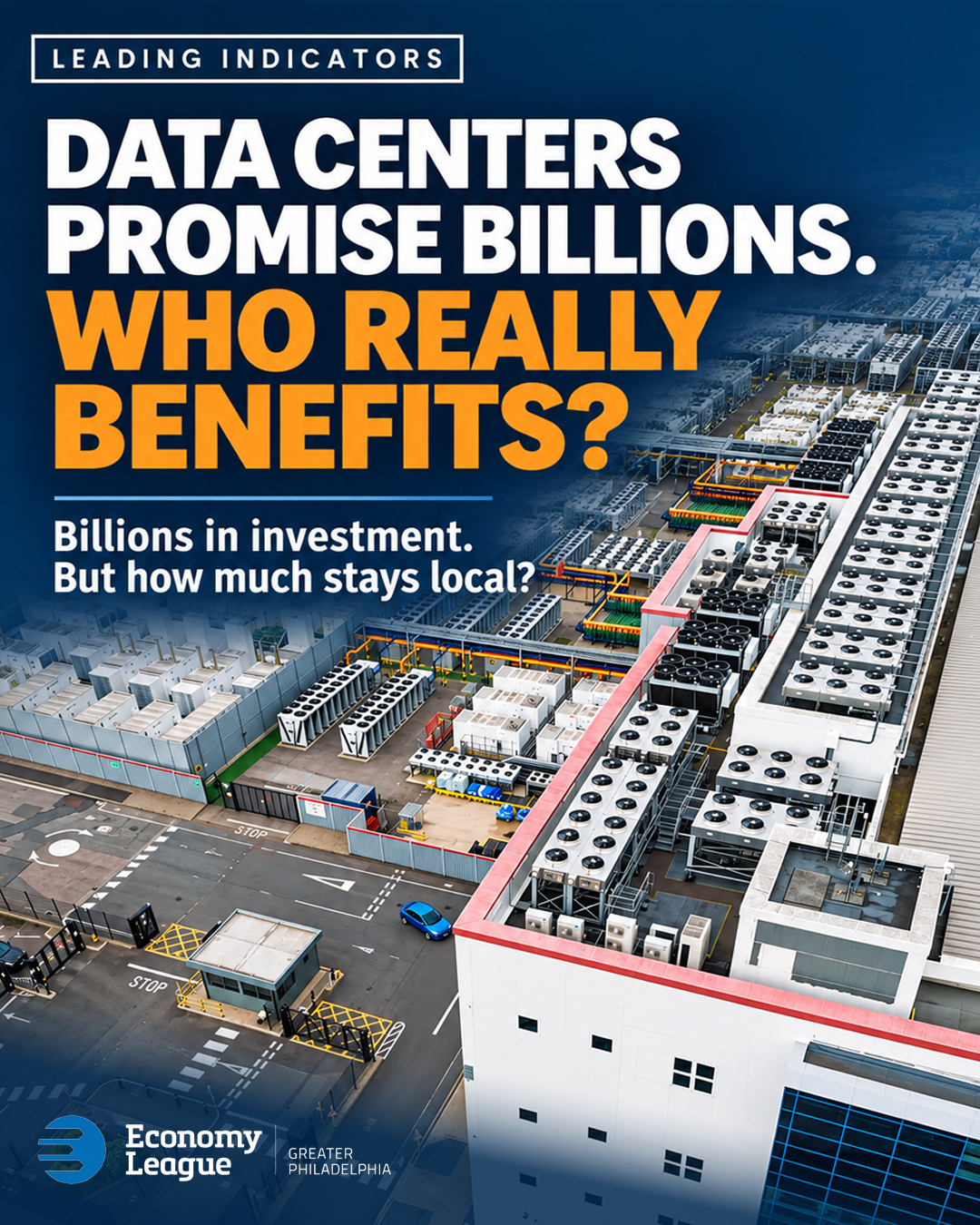
Despite the PA Supreme Court ruling in 2023 that found the Commonwealth’s deeply political system of allocating school funding unconstitutional, we still have annual fights about educational funding for our under-resourced urban and rural school districts. We are in the midst of significant change in the global labor market, as the economy shifts even more dramatically in two directions simultaneously: the rise of AI and its potentially negative impact on the historically weak middle of the labor market, and the need for huge numbers of skilled tradespeople to build data centers to power AI and to create modern infrastructure like affordable housing and transit and repair and modernize our dangerously ailing 20th century systems (eg. our power grids and bridges) before they completely collapse.
The siloing of the basic unit of talent development into largely tiny, property tax-funded fiefdoms called school districts, each with ruinously duplicative infrastructure, is perhaps the greatest exemplar of the triumph of ineffectual and parochial political federalism over regional economic strategy rooted in leveraging economies of scale. Other than politics, what is the possible rationale for the current state of affairs in public education? (One could make the same argument about community colleges, the building block of adult workforce development.)
The same holds for transit. The annual saga of SEPTA begging Harrisburg or PATCO begging Trenton to fund its woefully under-resourced enterprise, which provides essentially 19th century service in the 2nd quarter of the 21st century, would merely be tragicomical if it weren’t so consequential to regional economic health. While other countries such as China and Spain have built thousands of miles of modern high-speed rail that literally embodies regionalism infrastructurally, even the wealthiest US state, California, has failed to build even one mile to connect some of the most important tech hubs on the planet to give workers a shot at getting access to life-changing job opportunities. Closer to home, the residents of Chester County or North Philadelphia or Gloucester County have virtually no way other than 20th century roadways clogged with pollution-spewing vehicles creeping along at 20th century speeds, to truly access regional employment opportunities. There is a tremendous amount of wealth in this region; we must figure out ways to use it to reallocate opportunity far more equitably, through regional access to jobs and education. Where one is born must not dictate one’s life path. We need to rebuild the ladders and pulleys of social mobility.
Where one is born must not dictate one’s life path. We need to rebuild the ladders and pulleys of social mobility.
Stay Focused on Solutioneering!
The Democrats’ biggest challenge will be avoiding over-indexing 11/3/26 as some sort of a partisan mandate rather than an opportunity to shift from political parochialism and tribalism to inclusive problem-solving. What this region and country so desperately need right now is a decade of political stability that allows the problem-solving ethos that made America great to reestablish itself as the norm. If anything has become abundantly clear to the political scientist I once was, it is that the allegiances of the modern electorate are quite fluid and seeking a responsive government that centers markets rather than maps, that considers the common good rather than factional wins, that privileges good policy over political expediency. In sum: Let’s make America boring – but functional – again.
Jeff Hornstein, PhD
Executive Director
Economy League of Greater Philadelphia