Immigration as Economic Infrastructure: How Foreign-Born Workers Sustain Philadelphia’s Growth and Key Sectors

By Saloni Tandon, Director of Research & Analytics
With contributions from Ziqi Zhou, Analyst, Research & Analytics
Edited by Jeff Hornstein, Executive Director
February 24, 2026
This Leading Indicators analysis was featured in The Philadelphia Inquirer on February 27, 2026. Read the article here.
Philadelphia's economic vitality increasingly depends on its foreign-born population, a demographic shift that transformed the city from population decline to tentative stability. Foreign-born individuals (FIs) now comprise nearly 1 in 5 workers and contribute $7.4 billion in consumer spending while filling critical gaps from research labs to restaurant kitchens. As federal policy pressures mount, understanding this dependency becomes essential for economic planning and resilience.
What you need to know:
- Immigration Prevents Population Collapse – Without foreign-born individuals, Philadelphia would be shrinking. FIs comprise 16% of residents and nearly 1 in 5 workers[1], representing the primary engine of net population growth since 2000[2]. While the native-born population dropped by approximately 59,700 between 2010-2020, foreign-born individual inflows prevented overall decline[2].
- $7.4B Economic Footprint with Bifurcated Earnings – Philadelphia's FIs generated $7.4 billion in consumer spending and paid $2.3 billion in taxes in 2024[5], demonstrating substantial economic clout. However, foreign-born households earned a median of $58,357 compared to $62,829 for native-born households in 2024[13], reflecting a "barbell" distribution with concentration in both high-paying professional roles and lower-wage service positions[7].
- Dual Talent Pipelines Drive Economic Complexity – Foreign talent enters through institution-anchored pipelines (international students, research scholars, H-1B visas, STEM-OPT extensions) that supply universities, hospitals, and tech firms with advanced skills[3], and demand-driven pathways (family-sponsored immigrants, refugees, H-2B seasonal workers) that sustain labor-intensive sectors including hospitality, home care, and building services[3].
- Critical Healthcare Dependency Across Skill Levels – Approximately 26% of Pennsylvania physicians are foreign-born[8], while foreign-born individuals comprise nearly 40% of nursing aides and home health aides nationwide[9]. With 40% of STEM PhD degrees in greater Philadelphia earned by foreign students[10], research institutions depend heavily on international talent.
- Hospitality and Small Business Dependence – Foreign-born residents make up 25–30% of restaurant workers and 30–35% of hotel staff in Philadelphia, with ethnic restaurants often exceeding 40% foreign-born employment. They also own roughly 30% of the city’s small businesses—about 47,800 enterprises—nearly double their 16% population share.
- Foreign-born Entrepreneurs Punch Above Their Weight – Foreign-born residents own roughly 30% of Philadelphia's small businesses despite representing 16% of the population[6] – an entrepreneurship rate twice their demographic share. These 47,800 foreign-born individual-owned businesses generate diverse economic activity from corner stores to tech startups[14].
- Mid-Pack Among Peers with Room to Grow – Philadelphia's 16% foreign-born population now exceeds the national average (13-14%) and places the city mid-pack among peers[11], but traditional gateway metros like Houston and San Francisco maintain 25-35% foreign-born populations. Statewide, Pennsylvania's foreign-born individuals share (~8-10%) trails the U.S. overall[12], making Philadelphia's concentration especially consequential for the region.
1. The Population Arithmetic: Immigration as Growth Engine
Philadelphia's 21st-century demographic stabilization is an immigration story. Between 2010 and 2020, the native-born population declined by approximately 59,700 residents while foreign-born population growth offset these losses[2]. By 2024, FIs comprised 16% of Philadelphia's population – approximately 251,000 residents – and nearly 20% of the workforce[1], indicating higher labor force participation than native-born residents.
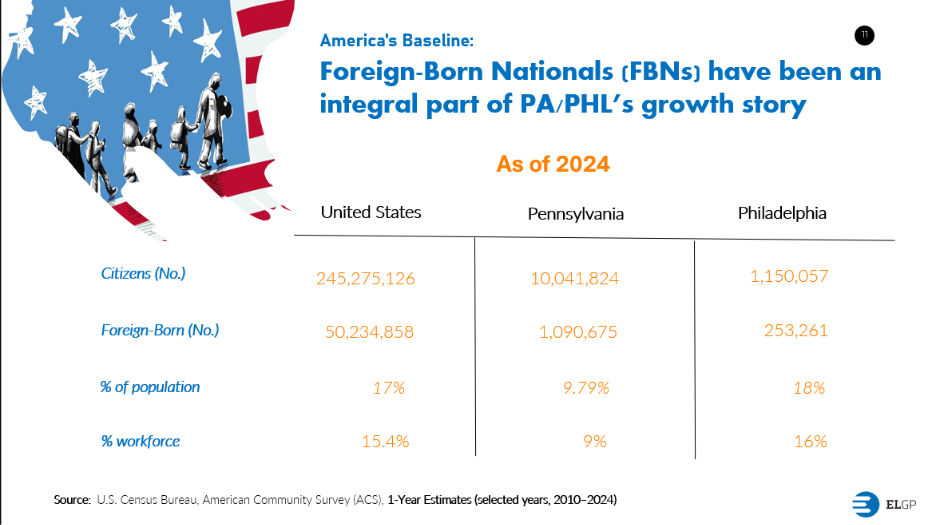
Pennsylvania's statewide context sharpens Philadelphia's distinctiveness. FIs comprise only 8-10% of state residents and about 9% of the workforce[12], making Philadelphia's concentration nearly double the state average. This geographic clustering reflects the city's institutional anchors – universities, hospitals, established ethnic communities – and contemporary pull factors.
Comparing Philadelphia to peer metros reveals progress and remaining gaps. Traditional gateways like Houston, San Francisco, and Miami sustain 25-35% foreign-born populations[11], while Philadelphia occupies middle ground – no longer an immigration laggard but not yet competing with top-tier global cities for international talent.
2. Dual Entry Pathways and Economic Contributions
Mechanism A: Institution-Anchored Pipelines
International students, research scholars, and H-1B skilled workers create structured talent pipelines concentrated in knowledge sectors[3].
Nearly 40% of STEM PhD degrees in greater Philadelphia are earned by foreign students[10], representing essential research capacity. These students transition from F-1 visas to Optional Practical Training, then compete for H-1B visas enabling long-term employment.
The healthcare system operates parallel pipelines. International medical graduates comprise approximately 26% of Pennsylvania physicians[8], entering through residencies sponsoring J-1 or H-1B visas. Teaching hospitals depend on these physicians for specialty clinics and underserved area staffing.
Mechanism B: Demand-Driven Pathways
Family-sponsored immigration, refugee resettlement, humanitarian parole, and temporary worker programs respond to labor demand signals in service sectors[3]. These FIs frequently enter lower-wage roles: restaurant staff, home health aides, building maintenance, and transportation services. H-2B seasonal visas fill temporary needs in hospitality and landscaping, while undocumented FIs comprise an estimated 5-7% of Philadelphia's workforce, concentrated in construction, restaurant kitchens, and domestic services.
Table 1: Common Visa Categories and Foreign-Born Pathways
| Pathway Type | Examples of Visa Categories | Typical Sectors | Notes |
|---|---|---|---|
| Institution-Anchored (High-Skill) | F-1 (international student), J-1 (exchange scholar/trainee), H-1B (specialty occupation worker), L-1 (intracompany transferee), O-1 (extraordinary ability), TN/E-3 (NAFTA/AUS professionals), STEM-OPT (extended practical training) | Universities, Research institutes, Healthcare systems (residents, researchers), STEM industries (tech, biotech) | Highly structured; tied to institutions (schools, employers). Often lead to employer sponsorship for green cards. Sensitive to policy changes, visa caps, and processing delays. |
| Demand-Driven (Labor & Family) | Family-sponsored visas (immediate relatives, family preference categories), Refugee/Asylee admissions, H-2A (seasonal agricultural worker), H-2B (seasonal non-agricultural worker), TPS/Parole (temporary protections) | Hospitality (hotels, restaurants), Home health care and nursing homes, Construction, Agriculture, Building services (cleaning, maintenance) | Less structured; driven by labor market needs and family ties. These workers often fill essential service roles[3]. Pathways can be indirect (e.g., coming on a tourist visa and overstaying to work). Very sensitive to enforcement and policy climate (deportations, visa quotas). |
Economic Impact: $7.4B Spending, $2.3B Taxes
In 2024, Philadelphia's FIs spent an estimated $7.4 billion on goods and services and paid $2.3 billion in taxes[5]. This includes federal income taxes, payroll taxes, state income taxes, sales taxes, and property taxes – contributions flowing from both documented and undocumented FIs.
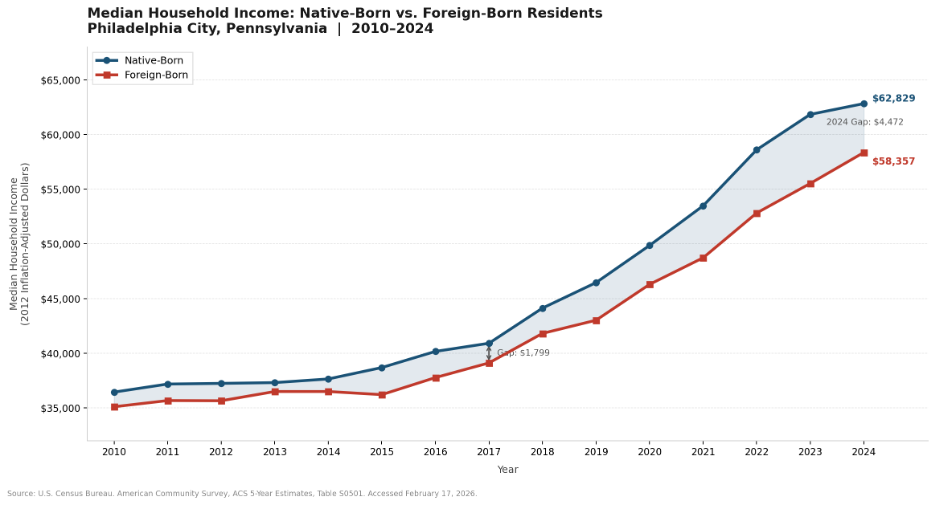
However, median household income reveals disparities. Foreign-born households earned $58,357 compared to $62,829 for native-born households in 2024[13].
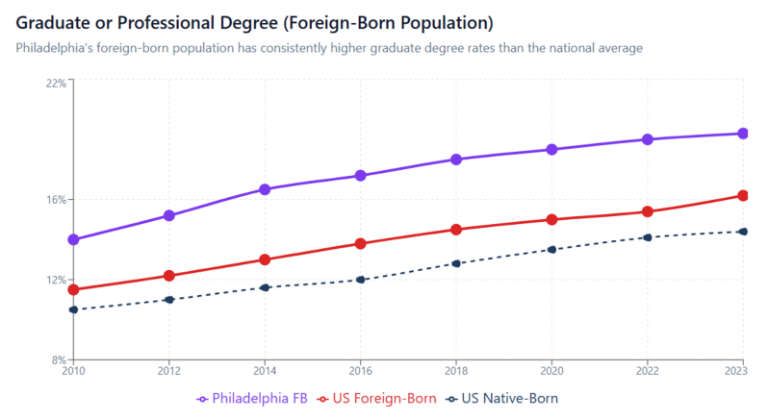
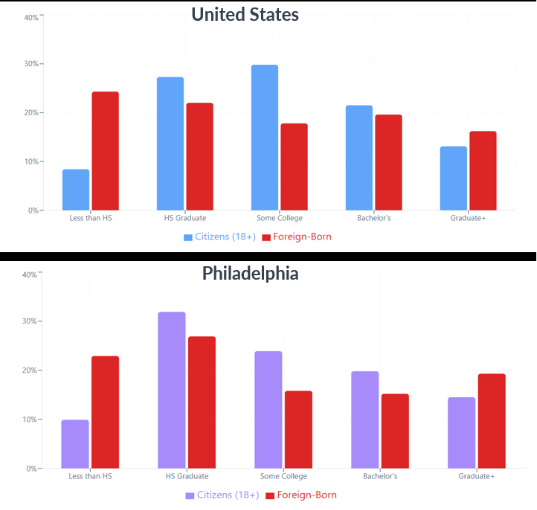 Education patterns help explain this income divergence. While foreign-born and native-born residents show near parity in overall higher educational attainment—34.5% of foreign-born residents hold a bachelor’s degree or higher compared to 34.3% of U.S.-born residents—the distribution of credentials differs sharply. Foreign-born residents are significantly more likely to hold graduate and professional degrees (19.3% versus 14.5% among native-born residents), but they are also more concentrated among those with a high school diploma or less. This simultaneous overrepresentation at both ends of the education spectrum creates a polarized earnings structure: a sizable cohort of highly educated professionals alongside a large group with limited formal credentials, shaping the overall income profile of foreign-born households.
Such income disparities reflect a "barbell" distribution: high-earning professionals (physicians, engineers, software developers) command salaries matching or exceeding native-born peers, while service sector workers earn substantially less. This bifurcation suggests underutilization of FI human capital – foreign-trained professionals working below their qualifications.
3. Sectoral Dependencies: Healthcare to Hospitality
Healthcare: Structural Reliance Across Occupations
Foreign-born workers span healthcare's full hierarchy. Approximately 26% of Pennsylvania physicians are foreign-born[8], with higher shares in primary care, geriatrics, and psychiatry where U.S.-trained physicians gravitate toward lucrative subspecialties. Nursing aides, home health aides, and personal care attendants show FI shares approaching 40% nationwide[9], likely higher in urban Philadelphia.
This dependency creates vulnerability. Without FIs, many healthcare facilities would face critical staffing gaps constraining service capacity and reducing access[8]. Recent policy changes restricting visa issuance have generated reports of unfilled positions and scaled-back services.
Universities: International Talent as Research Infrastructure
Nearly 40% of STEM PhD degrees in greater Philadelphia are earned by foreign students[10], representing thousands of researchers conducting experiments, analyzing data, and writing papers. The University of Pennsylvania alone enrolled over 5,000 international students in 2023[13], generating tuition revenue, conducting research that attracts outside funding, and contributing to institutional prestige.
Faculty ranks include substantial foreign-born representation, particularly in STEM fields where computer science, engineering, and biomedical departments often have majority foreign-born faculty. Recent visa restrictions create recruitment challenges as international PhD applicants factor political risk into enrollment decisions[3].
Hospitality, Food Service, and Small Business
Philadelphia's hospitality sector employs FIs at rates far exceeding their population share. Estimates suggest 25-30% of restaurant workers and 30-35% of hotel staff are foreign-born, with ethnic cuisine restaurants showing 40%+ FI employment. These positions offer modest wages and irregular hours, making them unattractive to many native-born workers but accessible for FIs establishing employment history.
FI entrepreneurship amplifies economic contributions. Approximately 30% of Philadelphia's small businesses are FI-owned[6] – about 47,800 enterprises[14] – representing an entrepreneurship rate double their 16% population share. Sector distribution spans restaurants, small retail, personal services, construction trades, and increasingly professional services and technology consulting.
Demographic Inevitability
Without sustained immigration, Philadelphia faces renewed population decline. Native-born residents are aging, fertility remains below replacement, and domestic migration favors sunbelt metros. Immigration provides the only plausible mechanism for population stability. Restrictive federal policies reducing legal immigration, slowing visa processing, or intensifying enforcement will accelerate population loss, while reforms expanding immigration could position Philadelphia to compete for global talent.
The strategic question isn't whether Philadelphia needs immigration – demographic arithmetic makes this undeniable. Rather, it's whether policymakers will embrace this reality through supportive policies and institutional investments, or whether political resistance will constrain growth and accelerate relative decline. Given the stakes, getting immigration policy right isn't optional – it's existential.
References
[2] Philadelphia's Evolving Immigrant Population Has Helped the City Grow | The Pew Charitable Trusts
[3] Economy League of Greater Philadelphia – Internal Analysis
[5] Immigration Facts: The Positive Economic Impact of Immigration | FWD.us (2020 fact sheet, PDF)
[7] The Demographics of Immigrant Workers in Philadelphia | The Pew Charitable Trusts
[8] Immigrants and Greater Philadelphia’s Healthcare Workforce | Economy League of Greater Philadelphia
[9] Immigrants and Greater Philadelphia’s Healthcare Workforce | Economy League of Greater Philadelphia
[11] The Demographics of Immigrant Workers in Philadelphia | The Pew Charitable Trusts
[12] U.S. Census Bureau.
[13] U.S. Census Bureau. "Selected Characteristics of the Native and Foreign-Born Populations." American Community Survey, ACS 1-Year Estimates Subject Tables, Table S0501
[14] Profile of the Foreign-Born Population: Philadelphia | Vera Institute of Justice (PDF)

